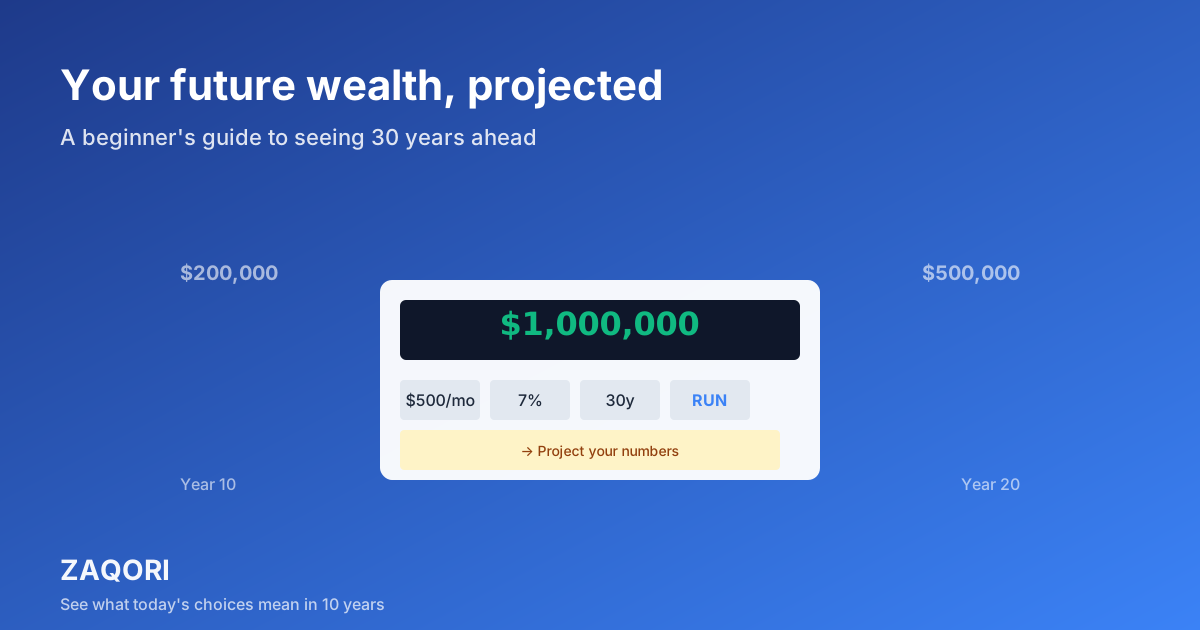
A future wealth projection is the most powerful tool available to people who are not yet wealthy. It is a simple, often eye-opening calculation that shows exactly what your current financial trajectory will produce in 5, 10, 20, and 30 years. This article explains what a future wealth projection is, what it tells you, and how to use one to make dramatically better financial decisions starting today. Whether you have $100 or $1,000,000, the projection is the same. The only thing that changes is the starting number.
What Is A Future Wealth Projection?
A future wealth projection is a calculation that takes your current savings, your current contribution rate, your expected return, and your time horizon, and projects what you will have at the end. The ZAQORI Future Wealth Simulator does this in real time with custom inputs.
The most basic version is: starting balance + (monthly contribution × months) + investment growth = ending balance. The investment growth depends on the rate of return and the time horizon. The longer the time horizon, the more dramatic the impact of the rate of return.
The most sophisticated versions include inflation adjustment, tax impact, contribution increases over time, and multiple scenarios (best case, expected case, worst case). The ZAQORI simulator includes all of these in a simple, interactive format.
What A Projection Tells You
A projection tells you three things, and they are all important. First, it tells you whether your current trajectory will meet your goals. If you project $400,000 at retirement but you need $1,000,000, you have a problem and you need to know it now, not at age 62. Second, it tells you what variables matter most. Is it the contribution rate? The return rate? The time horizon? The projection makes the trade-offs visible. Third, it tells you what changes you can make today that would have the largest impact. The ZAQORI Future Wealth Simulator lets you adjust each variable and see the result instantly.
The most important thing a projection tells you is whether you are on track. Most people are not. Most people have never done the calculation. When they finally do, the number is either a wake-up call or a confirmation. Both are valuable.
The Inputs You Need
You need four inputs for a basic projection. First, your current savings or net worth. This is your starting point. Second, your monthly contribution. This is what you are adding each month. Third, your expected annual return. For a balanced portfolio of stocks and bonds, 6-8% is a reasonable assumption. For a more aggressive equity portfolio, 8-10%. For a conservative bond portfolio, 3-5%. Fourth, your time horizon. This is how many years until you need the money.
The ZAQORI Future Wealth Simulator lets you input all four and see the result in seconds. You can also adjust the inflation rate, contribution growth rate, and tax assumptions for a more sophisticated projection.
The Most Common Projections
The most common projection is for retirement. The typical inputs are: $50,000 starting balance, $500 monthly contribution, 7% return, 30-year horizon. The result: roughly $1,000,000 in nominal terms, or $400,000 in today's dollars. Whether that is enough depends on your retirement lifestyle and other income sources. The ZAQORI Retirement Projection Simulator is specifically designed for this calculation.
The second most common projection is for a home down payment. The typical inputs are: $20,000 starting balance, $500 monthly contribution, 5% return (more conservative), 5-year horizon. The result: roughly $40,000 in nominal terms. Whether that is enough depends on your target home and the down payment percentage you need. The ZAQORI Savings Growth Simulator is designed for this calculation.
The third most common projection is for a child's education. The typical inputs are: $0 starting balance, $200 monthly contribution, 7% return, 18-year horizon. The result: roughly $90,000 in nominal terms. Whether that is enough depends on the type of education and the school's cost. The ZAQORI Future Wealth Simulator handles this calculation with custom inputs.
How To Use The Projection
The most important use of a projection is to compare scenarios. What happens if I increase my contribution from $500 to $750 a month? What happens if I delay retirement by 5 years? What happens if I invest in a higher-return portfolio? The ZAQORI Investment Growth Simulator lets you run these scenarios side by side and see the impact.
The second most important use is to identify the highest-leverage variable. For most people, the time horizon is the highest-leverage variable. Starting 5 years earlier often does more for your ending balance than increasing your contribution by 50%. The projection makes this visible.
The third use is motivation. A projection that shows you retiring with $1,000,000 instead of $400,000 is a powerful motivator. A projection that shows you retiring with $400,000 instead of $1,000,000 is a wake-up call. Both are valuable. The ZAQORI Future Wealth Simulator is designed to be motivational, not depressing.
Common Mistakes In Projections
The first mistake is using too high a return assumption. Investors who use 12% or 15% in their projections are setting themselves up for disappointment. A 7% real return is generous. Use 5% for planning. The ZAQORI Investment Growth Simulator shows the difference between aggressive and conservative return assumptions.
The second mistake is forgetting about inflation. A nominal projection of $1,000,000 is not the same as $1,000,000 in today's purchasing power. Over 30 years at 3% inflation, the real value is roughly $400,000. The ZAQORI Future Wealth Simulator includes inflation adjustment in the projection.
The third mistake is assuming contributions will stay flat. Most people's incomes grow over time, and most people's contributions should grow with their income. A projection that assumes flat contributions underestimates the ending balance for most people. The ZAQORI Savings Growth Simulator includes a contribution growth rate.
The Projection As A Decision Tool
The most powerful use of a projection is not to see what will happen if you do nothing. It is to see what will happen if you make specific changes. The ZAQORI Future Wealth Simulator is designed to be used as a what-if tool, not a calculator.
The most useful questions to ask:
- What if I save 5% more of my income?
- What if I start 2 years earlier?
- What if I invest more aggressively?
- What if I work 3 more years before retiring?
- What if I increase my contribution by 3% per year?
Run the projection with each change. See the impact. Pick the change that produces the largest impact per unit of effort. Implement that change first. Then run the projection again. Repeat.
What To Do With The Result
If the projection shows you are on track: stay the course. The discipline to keep doing what is working is harder than starting. Do not increase your lifestyle just because the projection is good. The ZAQORI Future Wealth Simulator lets you run the projection with various lifestyle inflation scenarios.
If the projection shows you are not on track: do not panic. Most people are not on track, and the projection gives you the time and information to change course. Increase your contribution rate. Extend your time horizon. Adjust your return expectations. Take action this week, not next year. The cost of every additional year of delay is significant. The ZAQORI Future Wealth Simulator shows the cost of each year of delay.
Frequently Asked Questions
How accurate is a future wealth projection?
A projection is only as accurate as its assumptions. The ZAQORI Future Wealth Simulator uses historical averages and conservative defaults. The result is a reasonable planning estimate, not a guarantee.
What return rate should I use?
For a balanced portfolio, 5-7% real (after inflation). For a more aggressive equity portfolio, 7-9% real. For a conservative bond portfolio, 2-4% real. The ZAQORI Investment Growth Simulator shows historical returns for different asset classes.
How often should I re-project?
Annually, or whenever there is a major life change (job change, marriage, home purchase, etc.). The ZAQORI Future Wealth Simulator takes seconds to use.
What if my projection shows I will not have enough?
The most common solutions are: increase contribution, increase time horizon, increase return rate, decrease goal. The ZAQORI Retirement Projection Simulator helps you find the right combination.
Should I use a financial advisor or do it myself?
For most people, a simple projection tool is sufficient. Financial advisors add value for complex situations, but the basic calculation is straightforward. The ZAQORI Future Wealth Simulator is designed for self-directed use.
Is it better to project in nominal or real terms?
Both. Nominal terms show the actual dollar amount. Real terms show the purchasing power. The ZAQORI Future Wealth Simulator shows both.
The Takeaway
A future wealth projection is the starting point for every good financial decision. It is the equivalent of a financial checkup, and most people have never had one. The ZAQORI Future Wealth Simulator is the easiest way to do it. Take 5 minutes, enter your numbers, see the result. The projection will either confirm you are on track or show you the gap. Either way, you will be more informed than 90% of people. The starting point of every wealth journey is a single projection, run honestly, with real numbers, today.