Twenty pages a day. That is what Jim Rohn, Warren Buffett, Bill Gates, and most of the most successful people in history have in common. They read every day, often for an hour or more, often for their entire adult lives. The habit sounds small, almost trivial. The results are anything but. This article is about the specific, measurable ways that daily reading compounds into a fundamentally different life over years and decades.
The Numbers Are Not What You Expect
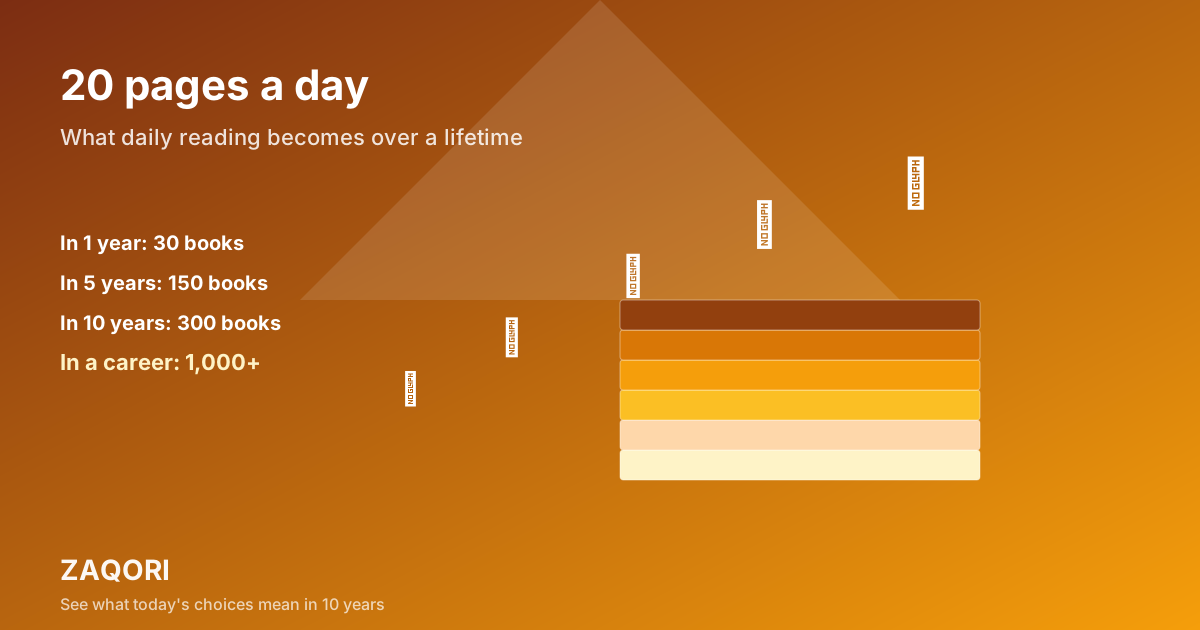
If you read 20 pages a day, you finish about 30 books a year. In a decade, that is 300 books. In a career, 1,000+. Most people read fewer than 5 books a year. The cumulative gap between heavy readers and light readers is staggering. The Reading Progress Simulator shows what daily reading becomes over 1, 5, 10, and 30 year horizons.
But the number of books is the least important metric. The most important metric is the compounding of knowledge. Each book gives you new mental models, new vocabulary, new perspectives. The next book you read is understood through the lens of every book before it. Heavy readers do not just accumulate information. They build a more sophisticated framework for understanding the world.
What Daily Reading Actually Does To Your Brain
Neuroscience has documented what readers have known intuitively for centuries. Daily reading increases neuroplasticity, builds white matter in the brain, improves memory and recall, sharpens focus and concentration, and reduces the risk of cognitive decline in older age. The effect is dose-dependent: the more you read, the more pronounced the benefits. The Learning Projection Simulator visualizes what daily learning becomes over years.
Heavy readers also score higher on tests of emotional intelligence, theory of mind, and social cognition. This is because fiction reading, in particular, requires the brain to model other people's thoughts, feelings, and motivations. Daily readers develop a more sophisticated understanding of other people, which translates directly into better relationships, better leadership, and better life outcomes.
The Career And Income Impact
Studies from the Social Science Research Network and others have consistently found that people who read 30+ minutes a day earn significantly more than people who do not. The gap varies by study, but 5-15% higher lifetime earnings is a common finding. Across a 40-year career, that is hundreds of thousands of dollars in additional income. The Career Growth Simulator shows what compounding career advantages become over time.
The mechanism is straightforward. Daily readers are better informed about their industry. They are more articulate, both in writing and speaking. They have more mental models for solving problems. They come across as more thoughtful and considered in meetings. They are more likely to be promoted, more likely to be trusted with key projects, and more likely to start successful companies.
The Specific Books That Compound
Not all reading is equally valuable. Reading social media posts and reading Tolstoy are not equivalent. The most compounding reading falls into three categories. The first is foundational works in your field. The second is biographies of people who have done what you want to do. The third is books that challenge your existing beliefs.
The ZAQORI Reading Progress Simulator lets you input your current reading rate and project what 1, 5, or 10 years of consistent reading will look like. Most people are surprised by the numbers.
The Habit That Is Easier Than You Think
The biggest objection to daily reading is time. People imagine sitting down for an hour. In practice, the most successful readers do it in 20-30 minute windows. They read during their morning coffee. They read on the train. They read for 20 minutes before bed. They listen to audiobooks during their commute. The total time is small, and the daily habit is far easier to maintain than people expect.
The first week is the hardest, because the habit is new and the pull of the phone is strong. After 14-21 days, the daily urge to read becomes automatic. After 90 days, you will feel uncomfortable on days when you do not read. The transformation is invisible from the outside, but profound from the inside. Use the Habit Builder Simulator to design a daily routine that includes reading.
What Happens After 5 Years
After 5 years of daily reading, you have read roughly 150 books. You have more domain knowledge than 95% of people in your industry. You have vocabulary and mental models that make you a more effective communicator. You have insights that translate directly into better decisions in your career, your relationships, and your finances. The compounding effect is now visible. The Reading Progress Simulator shows the 5-year inflection point.
The most surprising thing about year 5 is the realization that you have become a different person. The way you think about money, time, relationships, and risk has changed. The books you read did not just add information. They changed the structure of how you see the world.
What Happens After 20 Years
After 20 years of daily reading, you have read roughly 600 books. You have absorbed the major ideas from dozens of fields. You have a working understanding of history, science, philosophy, psychology, business, and human nature. You are not just well-read. You are one of the most well-read people in any room you walk into. The compounding effect is now transformative.
The people who achieve extraordinary things in their fields almost universally share one trait: they are readers. Not casual readers. Daily, consistent, lifelong readers. The habit is so common among outliers that it is hard to attribute their success to anything else. The Career Growth Simulator shows what compounding knowledge and skills do for a career over decades.
How To Start Tomorrow
Pick one book. The most successful readers always have a current book and a next book. Make a commitment to read 20 pages a day, every day, for 30 days. After 30 days, you will have finished a 600-page book. After 90 days, you will have finished three books. After a year, you will be in the top 10% of readers in your country. The Reading Progress Simulator shows your own year-one number.
The exact book matters less than the consistency. Pick something that interests you, that is not too hard, that you will actually finish. The first book is about building the habit, not about the content. The 50th book is when you can start to feel the compounding.
Frequently Asked Questions
What if I do not have time to read 20 pages a day?
Start with 5 pages. The ZAQORI Reading Progress Simulator shows what 5 pages a day becomes over a year. The number will surprise you.
Should I read fiction or non-fiction?
Both. Fiction builds empathy and theory of mind. Non-fiction builds knowledge and mental models. The ideal mix is roughly 50/50, but the specific mix is less important than the daily habit.
What if I forget what I read?
Take notes. Keep a "commonplace book" of quotes and ideas. The act of writing down what you read is part of the learning. Most heavy readers use a note-taking system like a physical journal or a digital app.
Are audiobooks as good as reading?
Audiobooks are excellent. They activate similar neural pathways to reading, and they let you read during activities where physical books are impractical. The ZAQORI Reading Progress Simulator counts audiobooks the same as physical or digital books.
What kind of books should I read?
Read what you are curious about. The most popular categories for personal development are biography, history, psychology, business, and philosophy. But the best book is the one you actually finish.
How do I keep the habit going long-term?
Stack it with an existing habit. Read during morning coffee, after dinner, before bed. The new habit piggybacks on the existing one and is much easier to maintain.
The Takeaway
Daily reading is the single highest-leverage habit for personal development. It costs almost nothing, requires no special equipment, and delivers compounding returns in knowledge, vocabulary, mental models, career outcomes, and life satisfaction. The people who change the world are not the people who read the most. They are the people who read consistently, for years, while everyone else stops. See your own reading projection at the Reading Progress Simulator, pick up a book tonight, and start your first 20 pages.