A single thousand dollars feels like a rounding error. It will not change your month, your year, or even your next vacation. But a thousand dollars invested today and left alone for thirty years becomes a sum that surprises almost everyone who does the math. This article is about that surprise, and the lessons it teaches about how money actually works.
The Real Numbers
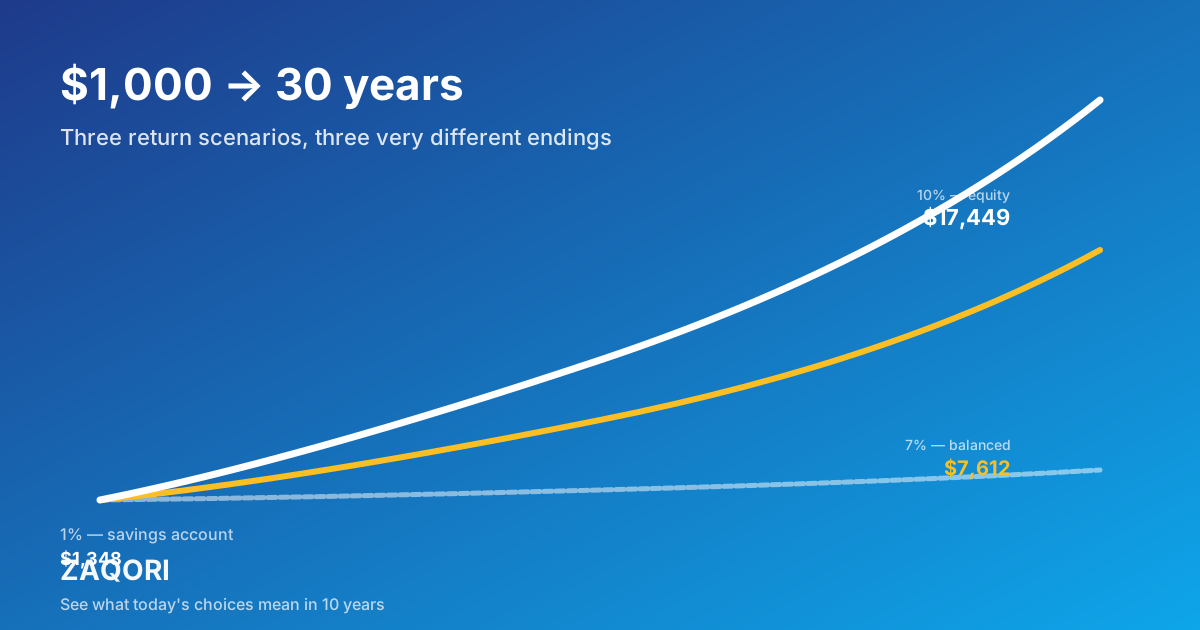
The same $1,000 grows dramatically differently depending on where you put it. At 1% (a high-yield savings account), it becomes about $1,348 in 30 years. At 4% (a conservative bond portfolio), it becomes about $3,243. At 7% (a balanced stock portfolio), it becomes about $7,612. At 10% (an aggressive equity portfolio), it becomes about $17,449. The exact return depends on what you invest in, but these are the realistic ranges. The Investment Growth Simulator lets you see your own projections with custom return assumptions.
The variance is enormous. A 3% difference in return, applied for 30 years, multiplies your ending balance by 2.3x. A 6% difference multiplies it by 5.4x. This is why people who pick the right long-term investments end up far wealthier than people who pick "safe" ones. The risk of low returns is real, even if it does not feel risky at the time.
The 30-Year Magic
The reason 30 years is a magic number is that it gives compounding three full decades to do its work. The first 10 years of any investment are mostly noise. The second 10 years start to show meaningful returns. The third 10 years are where the magic happens. By year 30, more than half of your ending balance in a 7% portfolio is interest, not principal. The $1,000 you put in becomes the smallest contributor to your final number.
This is why financial planners tell you to start investing at 25 instead of 35. The 10-year difference does not add 33% to your final number. It roughly doubles it. Time is the most powerful variable in the entire equation, and you can never get more of it.
The Three Forces Working On Your Money
There are three things happening to your $1,000 over 30 years. First, your money is earning returns. Second, those returns are being reinvested to earn more returns. Third, inflation is reducing the real purchasing power of the result. A 7% nominal return with 3% inflation is a 4% real return. Over 30 years, $7,612 nominal becomes about $3,250 in today's dollars. That is still triple your starting amount in real purchasing power, but it is less than the headline number suggests.
The most important takeaway: ignore nominal returns. Always think in real (inflation-adjusted) terms. A "10% return" with 8% inflation is barely 2% real growth. A "5% return" with 1% inflation is 4% real growth. The ZAQORI Future Wealth Simulator lets you factor in inflation directly.
Why Most People Do Not Invest The $1,000
The most common reason is that $1,000 feels too small to be worth the effort. Opening a brokerage account, picking investments, filing the tax forms — for $1,000, it feels like a hassle for a tiny payoff. This is the most expensive mistake in personal finance. The friction of starting is the same whether you invest $1 or $1,000,000, but the compounding cost of delay grows with every passing year.
The second reason is fear. People are afraid of losing the $1,000. They keep it in a savings account where inflation quietly reduces its value every year. A 3% inflation rate on $1,000 for 30 years means your $1,000 is worth about $412 in real terms. You did not "lose" the money, but you lost the purchasing power. The conservative choice is not conservative at all.
The third reason is procrastination. "I will start next year" is the most expensive sentence in personal finance. Next year becomes the year after. Ten years pass. The $1,000 that could have become $7,612 is still $1,000, plus whatever inflation has taken from it.
What To Actually Do With $1,000
Open a brokerage account today. Most major brokerages will let you start with any amount, including $1. Once the account is open, buy a low-cost total stock market index fund or an S&P 500 index fund. The expense ratio should be under 0.10%. Set up an automatic monthly contribution, even if it is only $25. The compounding effect of regular small contributions dwarfs a single $1,000 over time. The Savings Growth Simulator shows what consistent small monthly additions become over decades.
The decision to invest the $1,000 is more important than the choice of investment. A $1,000 invested in the "wrong" fund is still better than a $1,000 sitting in a checking account losing 3% a year to inflation.
The 30-Year Lesson
The lesson is not that $1,000 will make you rich. It is that small amounts, given enough time and a reasonable return, become large amounts. The same math that turns $1,000 into $7,612 turns $100,000 into $761,200. The principles are identical. The scale changes. Anyone who understands this can build wealth, regardless of starting point.
What separates people who build wealth from people who do not is not the size of their paycheck or the brilliance of their investment picks. It is the willingness to start with whatever they have, automate the system, and wait. See your own $1,000, $5,000, or $50,000 projection at the Investment Growth Simulator.
Frequently Asked Questions
What if I cannot afford to invest $1,000 right now?
Start with $50 or $100. The compounding still works. The only thing that matters is starting.
Is 7% return guaranteed?
No. Some years will be down 30%, others up 25%. The 7% is an average over 30 years. It is a planning number, not a guarantee.
What if I need the money in 5 years?
Then invest it more conservatively. The 30-year horizon is what makes aggressive investing reasonable. Short horizons need capital preservation.
Should I invest in individual stocks instead of index funds?
Beginners should not. Index funds give you instant diversification and are nearly impossible to underperform with stock picking.
What about taxes?
Use tax-advantaged accounts like 401(k)s, IRAs, or Roth IRAs whenever possible. They shield your compounding from annual tax drag, which is a huge boost over 30 years.
Can I lose all my money?
In a diversified index fund, you cannot lose your entire investment. You can experience significant temporary losses. The 30-year horizon is what makes those losses recoverable.
The Takeaway
A thousand dollars is not a number. It is a test. The question is not "how much will it become" but "will you start the process." The math is the math. The only variable is whether you choose to participate. Run your own projection at the Future Wealth Simulator and make the decision today.
Putting The Number In Perspective
The headline figure of $7,612 sounds modest, but its meaning becomes clear only when you compare it to the alternative. A $1,000 saved in a checking account, in real purchasing power, becomes about $412 in 30 years. The investing path produces 18 times that number. The $7,200 difference, for a single $1,000 decision made once, is more than most people save in an entire year of normal saving. The Future Wealth Simulator lets you run this comparison for any amount.
The number is also more powerful when scaled. A $1,000 one-time investment is a windfall or a gift. A $1,000 monthly investment, sustained for 30 years, is a multi-million-dollar outcome. The same compound interest formula applies. The only difference is the contribution amount. The lesson scales: small amounts invested early become large amounts, and the larger the base, the more dramatic the compounding. The ZAQORI Investment Growth Simulator shows the difference between a single $1,000 and a sustained $1,000 monthly contribution over 30 years.
The third perspective is psychological. Knowing that a $1,000 investment today becomes a meaningful sum in 30 years changes how you think about the next $1,000 you have to allocate. The opportunity cost of spending it on something short-term becomes vivid. You stop thinking of $1,000 as a purchase and start thinking of it as a future $7,600. That mental shift is the gateway to all subsequent financial decisions. The Savings Growth Simulator shows what consistent savings become when you internalize the compounding mindset.