Two hours a day on social media does not feel expensive. The app is free, the content is endless, and the time passes quickly. But when you multiply that two hours across an entire adult lifetime, the numbers become sobering. This article calculates the true cost of social media over 50 years, including time, money, opportunity, and health. The result is one of the largest expenses most people will ever have, and almost nobody accounts for it.
The Lifetime Time Cost
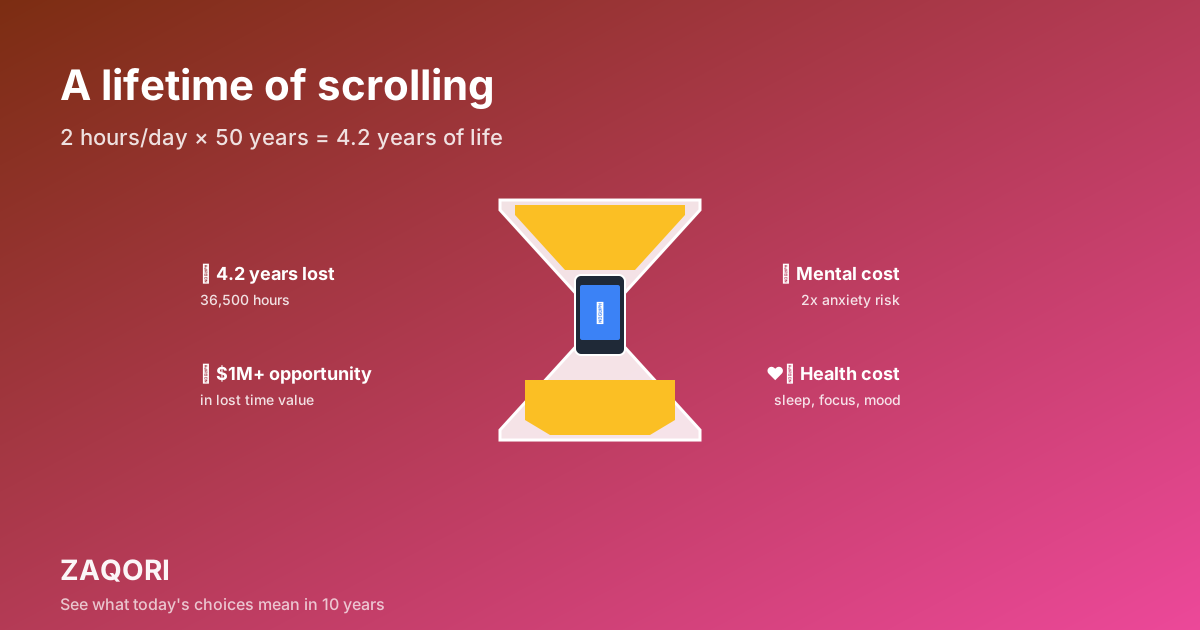
Two hours a day, every day, for 50 years, is 36,500 hours. That is 1,520 days, or roughly 4.2 years of continuous scrolling. Imagine losing four years of your life to an app. The time cost is real even before you assign a dollar value to it. The Social Media Cost Simulator lets you see exactly how many years you are spending on social media based on your actual usage.
That four years could be spent on almost anything. Reading 30 books a year, you could have read 1,500 books. Exercising 30 minutes a day, you could have become a different person physically. Building a side business 10 hours a week, you could have launched something meaningful. The opportunity cost of four years of attention is incalculable, because the things you could have done in those four years are infinite.
The Lifetime Money Cost
The financial cost of social media comes in three forms. First, there is the time value. If your time is worth $30 an hour (the US median), those 36,500 hours represent $1,095,000 of unrealized lifetime earnings potential. If your time is worth $50 an hour, it is $1,825,000. The Time Value Simulator calculates this for your actual wage.
Second, there is the direct spending. Studies show heavy social media users spend 20-40% more on impulse purchases than light users, driven by the advertising and product placement embedded in feeds. Over 50 years, even a modest $200/month in extra impulse spending compounds to a staggering sum.
Third, there is the health cost. Heavy social media use is correlated with poorer sleep, more sedentary time, and higher rates of anxiety and depression. Healthcare costs associated with these issues over a lifetime can easily reach six figures. The Sleep Impact Simulator shows the long-term health costs of sleep disruption caused by late-night scrolling.
The Math Is Worse Than You Think
Most people think of social media cost in terms of an annual subscription. "If I cut social media, I save $0 because it is free." This is wrong. The cost is not a subscription. It is the present value of the time, money, and health you are trading for the use of the platform. By that measure, social media is one of the most expensive products most people will ever consume, and they are paying for it with their lives.
If you invested the equivalent of the money you save by not impulse-buying, plus the income from the time you reclaim, the lifetime wealth difference between heavy and light social media users is in the millions of dollars, even with conservative assumptions. The Future Wealth Simulator shows what you could build with that recovered time and money.
The Health Cost Is Real
Beyond the abstract dollar figures, the health costs of heavy social media use are documented and serious. A landmark study published in JAMA Psychiatry found that adults who used social media more than 3 hours a day had double the risk of depression and anxiety compared to light users. Other research has linked heavy use to disrupted sleep, increased loneliness, lower self-esteem, and weakened attention span.
The cost of these conditions, measured in therapy appointments, medication, lost productivity, and reduced quality of life, is enormous. Multiply it across a lifetime and you are looking at a sum that would dwarf any subscription service you have ever paid for. Yet most people do not even consider social media a "health" expense.
The Opportunity Cost Is The Real Cost
The most important number is not the time cost or the money cost. It is the opportunity cost. The four years of attention you spend on social media could have been four years of building expertise, deepening relationships, developing a craft, or creating something. The things you could have done with those four years do not have a fixed dollar value. They are unique to you, your talents, and your goals.
The most successful people in any field will tell you that what separated them was not talent or luck. It was the consistent application of attention over years. The painter, the programmer, the founder, the surgeon — all of them invested the kind of focused attention that social media, by design, prevents. The Productivity Growth Simulator shows what focused, distraction-free time delivers over a career.
A Realistic Path To Reducing The Cost
You do not have to quit social media entirely to recover most of the cost. Cutting from 2 hours a day to 30 minutes a day reclaims 1.5 hours of attention, every day, for the rest of your life. That is 547 hours per year, 27,375 hours over 50 years. Use the Habit Builder Simulator to design a daily routine that includes the social media time you want and the deep work you need.
The single most effective intervention is removing social apps from your phone and using the web version only. The friction of opening a browser cuts usage by 60-80% in most studies. Combined with setting two specific "social media times" each day, you can reduce lifetime cost by 80% while still keeping up with the people and content that matter.
Frequently Asked Questions
What if I use social media for work?
Even for work, the cost is still real. Use dedicated tools like a social media scheduler, batch your work usage into 30-minute windows, and do not use the consumer apps for work.
Are some platforms worse than others?
Yes. Algorithmically-driven short-form video platforms (TikTok, Instagram Reels, YouTube Shorts) are the most costly. Static platforms with intentional use (LinkedIn, X) cost less.
Can I get the benefits (connection, learning) elsewhere?
Most benefits are available through newsletters, podcasts, books, and direct conversations. The marginal value of social media is much lower than it feels.
What if my friends and family are only on social media?
Set one weekly 30-minute call with the people who matter. It is a higher-quality connection than 100 likes ever will be.
How do I actually cut back?
Delete the apps from your phone tonight. Replace the habit with one deliberate action: a walk, a book, a call. After two weeks, the urge fades significantly.
Is the cost really that high for a casual user?
Even one hour a day for 50 years is 18,250 hours, or 760 days. The cost scales with usage, but even light users are paying a meaningful price.
The Long View
The hidden cost of social media is not a single number. It is a portfolio of costs that compound over a lifetime. Time, money, health, attention, and opportunity all flow away from you every day you use these platforms without intention. The good news is that the cost is reversible. Cut back today, reclaim your attention, and watch the lifetime numbers shift. See your own personal cost at the Social Media Cost Simulator.