One hour a day feels like a small thing. In the moment, scrolling for an hour, watching TV for an hour, or doing any other low-value activity for an hour does not register as a significant choice. The hour passes. The day continues. But when you multiply one hour per day across a year, a decade, or a lifetime, the cost is breathtaking. This article calculates the real, multi-dimensional cost of wasting one hour every day, and it is far more than most people imagine.
The Time Cost Is The Obvious One
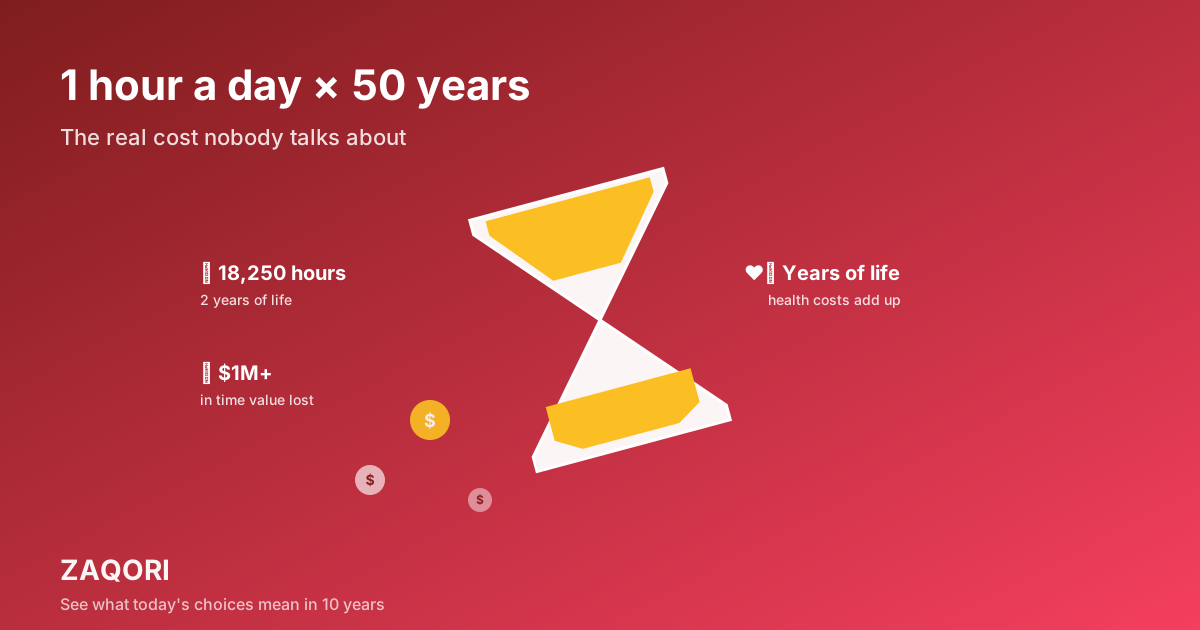
One hour a day, every day, for 50 years, is 18,250 hours. That is 760 days, or roughly 2 years of continuous wasted time. Two years of your life, gone. The ZAQORI Time Value Simulator shows exactly how many years of your life you are spending on different activities.
Two years of attention could have produced a professional certification, a second language, a published book, a fully fit body, a substantial savings balance, or a deep, meaningful relationship. The opportunity cost of one wasted hour a day is not abstract. It is the specific, concrete, irreversible loss of the things you could have done with that time.
The Money Cost Is Staggering
If your time is worth $30 an hour (the US median wage), 18,250 hours is $547,500 of unrealized lifetime earning potential. If your time is worth $50 an hour, it is $912,500. If your time is worth $100 an hour (common for skilled professionals), it is $1,825,000. The Time Value Simulator lets you calculate your personal number.
This is the present value of what you could have earned, invested, or built with that time. It is the largest single expense in most people's lives, and it is rarely visible because it is paid in time rather than money.
The Health Cost Is Real
The activities that fill most "wasted" hours are not neutral. Scrolling social media, watching TV, doomscrolling news, playing games — all of these are associated with measurable negative health outcomes. Increased sedentary time, sleep disruption from blue light, mental health impacts from comparison and anxiety, and reduced time for exercise. The ZAQORI Sleep Impact Simulator shows the long-term health cost of disrupted sleep caused by late-night scrolling.
The health costs of these activities, measured in medical bills, lost productivity, and reduced quality of life, can easily reach $100,000-$300,000 over a lifetime. The conservative estimate is that one wasted hour a day costs $50,000 in healthcare spending over a 50-year adult life.
The Career Cost Is Invisible
Every hour spent on low-value activities is an hour not spent on career-building activities. Reading industry publications, building professional relationships, developing new skills, working on side projects, getting certifications — these are the activities that compound into promotions, raises, and career growth. The ZAQORI Career Growth Simulator shows what consistent career-building time delivers over decades.
A one-hour-a-day investment in your career, compounded for 10 years, is roughly 3,650 hours of focused skill development. That is enough to become genuinely expert in a new area, transition to a higher-paying field, or build a side business that becomes a primary income. The opportunity cost of wasting that hour is not a single number. It is the entire alternate career path you could have built.
The Relationship Cost Is The Most Personal
The most expensive cost of wasted time is not financial. It is the relationships you could have deepened. Every hour you spend scrolling is an hour you could have spent with a partner, a child, a parent, a friend. The moments you lose with the people you love are not recoverable. The ZAQORI Decision Outcome Simulator shows the long-term impact of small daily decisions on your most important relationships.
The people who report the highest life satisfaction in their 70s and 80s are almost universally the people who prioritized relationships over the decades. The people who report the deepest regrets are the people who realized too late that they had been physically present but mentally absent. The wasted hour a day is, in many cases, a slow leak of intimacy, attention, and connection that cannot be repaired later.
The Math Is Worse Than You Think
If you took the money you would earn during your wasted hour, invested it at 7%, and let it compound for 30 years, the total is enormous. For a $30/hour earner, 1 hour a day invested at 7% for 30 years is roughly $1,800,000. For a $50/hour earner, it is roughly $3,000,000. The Future Wealth Simulator shows your own number.
The same is true for the cumulative cost of the activities themselves. The subscription to Netflix, the data plan, the food delivery, the impulse purchases — all of these are real, recurring costs of the wasted hour. The ZAQORI Time Value Simulator includes both the time cost and the associated spending.
What To Do With The Recovered Hour
The single most effective intervention is to identify the lowest-value hour in your day and replace it with a high-value activity. For most people, the wasted hour is in the evening, between dinner and bed. The most common replacement is exercise, reading, skill development, or quality time with family. The ZAQORI Habit Builder Simulator helps design a replacement routine that you will actually stick with.
The key is to choose one replacement activity, not a long list. The most effective replacements are:
- 30 minutes of focused reading (the Reading Progress Simulator shows the result)
- 30 minutes of exercise (the Fitness Progress Simulator shows the result)
- 30 minutes of skill practice (the Learning Projection Simulator shows the result)
- 30 minutes of family time (no simulator, but the result is the most important)
You do not need to fill the entire hour. Even 30 minutes of high-value activity, replacing 60 minutes of low-value activity, transforms the math.
The Lifetime Difference
A person who wastes one hour a day for 50 years ends up with less wealth, worse health, weaker relationships, and a less accomplished career than a person who invests that hour consistently. The differences are not small. They are life-altering. The ZAQORI Life Progress Timeline Simulator shows the cumulative effect of these small daily choices over a lifetime.
The most important thing to understand is that the cost of one hour a day is not a single number. It is a portfolio of costs across time, money, health, career, and relationships. The total is in the millions of dollars and the loss of years of healthy, productive, fulfilling life. The intervention is free: stop wasting the hour. Replace it with anything high-value. The result is the same: a fundamentally different life in 10, 20, 30 years.
Frequently Asked Questions
Is one hour a day really that significant?
Yes. The ZAQORI Time Value Simulator shows that one hour a day, for 50 years, is 2 years of life. Most people are shocked by this number.
What counts as "wasted" time?
Any activity that does not produce value for your long-term goals, health, or relationships. Common examples: passive scrolling, doomscrolling, low-quality TV, pointless web browsing.
What if I am resting?
Rest is valuable. The issue is not rest. The issue is the specific kinds of low-value consumption that masquerade as rest but are actually depleting.
Can I recover the lost time?
Not directly. But you can prevent further loss and start compounding high-value time starting today. The ZAQORI Future Wealth Simulator shows your own number.
What if my job already takes 10 hours a day?
Then your wasted hour is even more expensive. The opportunity cost of rest is rest. The opportunity cost of low-value activity, when you are already tired, is enormous. Use the Time Value Simulator to see your specific number.
How do I actually stop wasting the hour?
Delete the apps. Move the TV out of the bedroom. Replace the activity with a specific, scheduled alternative. The ZAQORI Habit Builder Simulator helps design a routine that sticks.
The Takeaway
One hour a day does not feel like much. A year from now, you will have used 365 hours. A decade from now, 3,650. A lifetime, 18,250. Those hours could be the foundation of expertise, fitness, deeper relationships, or significant wealth. Or they could be lost to a feed that forgot you the moment you scrolled past. The math is the math. The choice is yours, and you can make it starting tonight. See your own personal number at the Time Value Simulator.