The most expensive decision in personal finance is not picking the wrong investment. It is waiting to start. Every year you delay is a year of compounding you can never recover, and the gap between early investors and late investors is far larger than most people imagine. This article walks through exactly what happens to two otherwise identical investors, and the answer will reshape how you think about your own timeline.
The Two Investors
Imagine Sarah and Mark, both 22, both earning the same salary, both committed to retirement investing. Sarah starts immediately, contributing $200/month to a balanced index fund at 7% average return. Mark decides to wait "until things are more stable." Mark finally starts at 32, contributing $400/month (double Sarah's amount, since he is now more established) to the same investment.
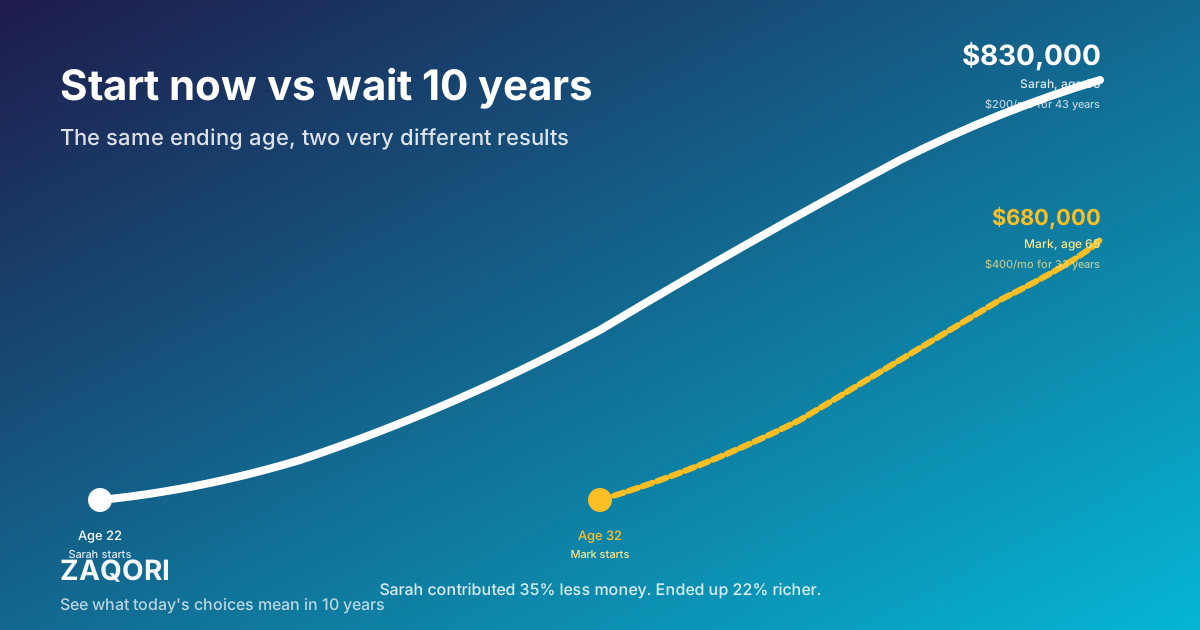
Both retire at 65. The question is: who has more? The intuitive answer is Mark, because he contributed more money. The actual answer is Sarah, by a wide margin. Sarah's $200/month for 43 years grows to roughly $830,000. Mark's $400/month for 33 years grows to roughly $680,000. The Investment Growth Simulator shows this calculation in detail.
Sarah contributed $103,200 total. Mark contributed $158,400 total. Sarah contributed 35% less money and ended up with 22% more wealth. The reason is the 10 extra years of compounding on Sarah's early contributions. The early years are doing the heavy lifting.
Why The Early Years Are So Powerful
The first few years of any investment are dominated by small numbers. A 7% return on $1,000 is $70. That is not impressive. But the 7% is being applied to a base that grows. By year 10, the 7% is being applied to a much larger base, and the annual return becomes meaningful. By year 20, the annual return is significant. By year 30, the annual return exceeds the total contributions of the first decade.
The ZAQORI Future Wealth Simulator shows the inflection point when compounding starts dominating contributions. For most investors, this is around year 15-20. The investors who started at 22 hit this point at 37-42. The investors who started at 32 hit it at 47-52, and have less time to benefit from the dominance.
The Cost Of Each Year You Wait
If you can invest $300/month at 7% return for 40 years, starting at 25, you end with roughly $720,000. If you start at 26 instead, you end with $700,000. The cost of one year of delay is $20,000. Two years of delay costs $40,000. Five years of delay costs $120,000. Ten years of delay costs $320,000.
Each year you delay is expensive. This is not a linear cost. The compounding loss accelerates the longer you wait. The Future Wealth Simulator shows the precise cost of each year of delay, given your specific contribution and timeline.
The Three Reasons People Wait
The first reason is "I do not have enough money yet." This is the most expensive reason. $25 a month is enough. $50 is better. The amount is less important than starting. The Savings Growth Simulator shows what small consistent contributions become over decades.
The second reason is "I do not understand investing yet." This is solvable in a weekend. There are excellent beginner resources, and the basic concepts are not complicated. Open a brokerage account. Buy a low-cost index fund. That is the entire strategy for the first few years.
The third reason is "The market might be at a high." This is sophisticated-sounding but wrong. Time in the market beats timing the market. Even investing the day before a major crash produces a better 30-year return than waiting for the "right" entry point, because the market recovers and the wait costs you years of compounding.
The Behavior That Wins
The behavior of early investors is not glamorous. It is not exciting. It is the boring habit of automatic monthly contributions, started as early as possible, increased gradually over time, and never stopped. The early investor does not check their balance daily. They do not try to time the market. They do not panic during downturns. They simply contribute and wait. The ZAQORI Investment Growth Simulator shows what this boring behavior becomes over 40 years.
The late investor, by contrast, often feels urgency. They want to "catch up." They contribute more than they can sustainably afford. They invest aggressively. They check their balance constantly. They panic during downturns. The behavior pattern of the late investor often produces worse results than the early investor, even with more money contributed.
What To Do Today
If you are under 30 and not yet investing, start this week. Open an account. Set up an automatic transfer. Invest in a low-cost index fund. The amount does not matter. $25 a month, started at 25, becomes more than $500 a month started at 35, given enough time. The Future Wealth Simulator shows your own number.
If you are over 30 and not yet investing, start this week anyway. The compounding loss for each additional year of delay is significant, but the cost of never starting is infinite. A late start is far better than no start. The Investment Growth Simulator shows the difference between starting now and starting in 5 years.
The Power Of Doubling Down
If you have already been investing for a few years, the early years you missed can never be recovered. But you can do the next best thing: increase your contribution rate aggressively. A 25-year-old contributing $300/month is not far behind a 22-year-old contributing $500/month. By age 40, the gap can be closed. The ZAQORI Future Wealth Simulator shows what aggressive catch-up contributions can do.
The most powerful tool in your catch-up toolkit is the "raise rule": every time you get a raise, direct at least half of it to your investment contribution. People who follow this rule often retire with multiples of what they would have had otherwise.
Frequently Asked Questions
Is it really better to start small now than wait until I can contribute more?
Yes. The compounding effect of early small contributions beats larger late contributions in the majority of cases, particularly for retirement timelines.
What if I am 40 and just starting?
Starting at 40 is still much better than starting at 50. The compounding loss for each year of delay is real, but the cost of never starting is worse. Use the Future Wealth Simulator to see your specific numbers.
What if I cannot afford to invest anything right now?
Save $25-50 per month in a high-yield savings account. Even at 4%, this builds a small base for when you can start investing. The ZAQORI Savings Growth Simulator shows what small consistent savings become.
Should I pay off debt first or invest?
It depends on the interest rate. Generally, pay off high-interest debt (over 7%) first, then invest. Low-interest debt (under 5%) can be paid off on schedule while you invest. There are exceptions, but this is a good rule of thumb.
What if the market is "overvalued"?
The market has been "overvalued" for most of the last 100 years. Time in the market beats timing the market. Investors who waited for the "right" entry point consistently underperform investors who just stayed invested.
What if I lose money?
You will, in some years. That is normal. Over 30+ year horizons, the market has never lost money in real terms. The ZAQORI Investment Growth Simulator shows historical 30-year returns and the rarity of negative long-term results.
The Takeaway
The decision to start investing today, with whatever amount you can afford, is more important than the decision of what to invest in. Early small contributions beat late large contributions. The investors who retire wealthy are not the investors who picked the best funds. They are the investors who started the earliest and never stopped. See your own early-investor projection at the Future Wealth Simulator and start this week.