Most people underestimate small numbers. Ten dollars feels trivial — less than a pizza, less than a tank of gas, less than a forgettable Tuesday-night dinner. But ten dollars saved every single day, for twenty years, quietly becomes one of the largest sums most people will ever see without earning it. This article does the math, and the answer is uncomfortable in a good way.
The Actual Math
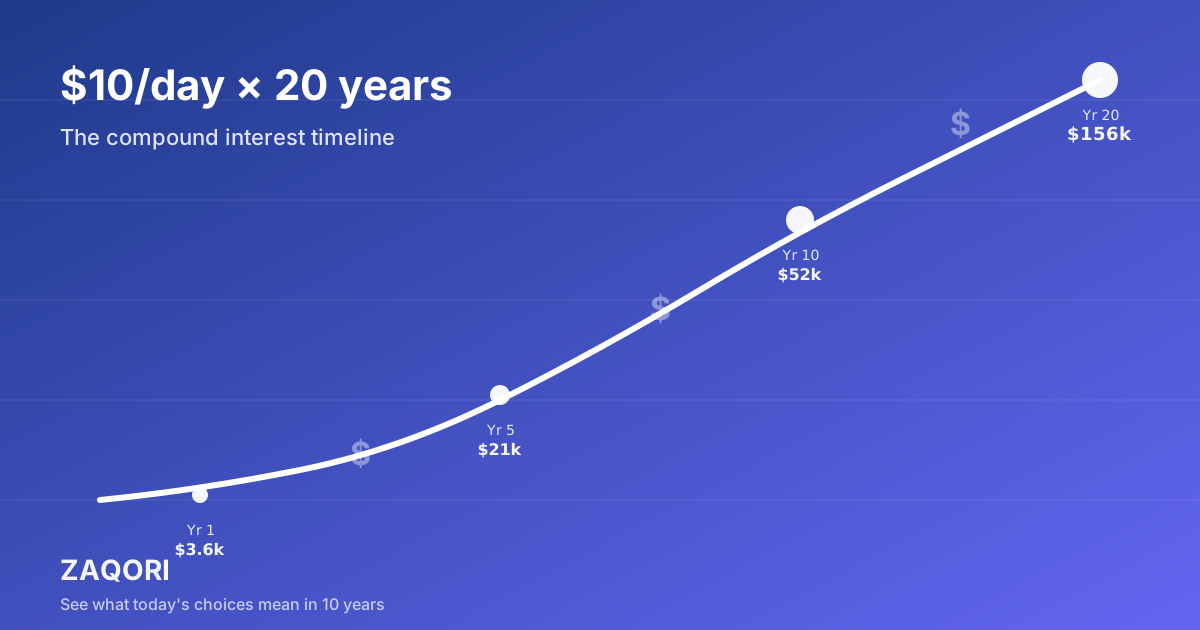
Saving $10 a day is $3,650 a year. That is the part most people get. The part they do not get is what happens in years 11 through 20, when the earlier deposits start earning returns on themselves. At a 7% average annual return (a reasonable long-term assumption for a balanced portfolio), the timeline looks like this.
After 5 years you have about $21,000. After 10 years you have roughly $52,000. After 15 years you have about $98,000. After 20 years you have approximately $156,000. That is the power of a number that felt too small to matter. Try the Future Wealth Simulator to see your own number with different rates of return and time horizons.
Why the Early Years Feel Useless
In the first three years, your balance is small and the growth is uninspiring. Saving $10 a day for a year gets you $3,650 minus a few months of fees, and you are looking at something like $3,400. The temptation to stop is highest right when you should be most consistent. This is the most important insight of the entire article: the first 36 months of any long-term savings plan are almost entirely about building the habit, not the balance.
The compounding only becomes visible around year 7 or 8, when the interest starts producing meaningful numbers. By year 12, more than a third of your balance is interest. By year 20, almost half of it is. Use the Savings Growth Simulator to see exactly when your own balance crosses the threshold where growth starts funding growth.
The $10 Doesn't Have to Be Cash
A common objection is "I can't just save $10 a day, my budget is too tight." That is fair, but the principle is broader than literal cash. You can apply the same math to:
- $10 of avoided Uber Eats or food delivery, banked instead
- $10 of canceled subscriptions you forgot about
- $10 of avoided impulse purchases from social media
- $10 of "found money" from selling things you do not use
- $10 of saved energy costs from small habit changes
The point is not that $10 must come from a paycheck. The point is that $10 in the bank today is $10 plus years of compounding tomorrow. The source matters less than the discipline.
The Three Levers That Change Everything
If you can stack even small advantages, the math changes fast. The first lever is time. Starting today instead of next year adds thousands. The second lever is return. Moving from a 0.01% savings account to a 7% balanced portfolio multiplies your final number by roughly 4x. The third lever is consistency. Missing one day a week instead of saving daily cuts your 20-year result by about $30,000. See the Investment Growth Simulator for how small return differences compound over decades.
What Most People Get Wrong
The biggest mistake is treating $10 as too small to bother with. The second biggest is treating it as a fixed amount and never increasing it. A 5% annual increase to your daily savings (less than the rate of inflation in most years) more than doubles your 20-year result. The third biggest mistake is investing in something with a low expected return and assuming the math will work out. It will not. A 2% return over 20 years gets you about $95,000, which is meaningful but not transformative. A 7% return gets you $156,000. A 10% return gets you $228,000. The difference is the return assumption.
How to Actually Start This Week
Open a brokerage account or a high-yield savings account this week. Set up an automatic transfer of $10 from your checking account on the day after payday. Treat it as a non-negotiable monthly bill. After 90 days, raise it to $12. After 6 months, raise it to $15. By the end of year two, you will be saving $20 a day and you will barely feel it. That is when the real compounding begins.
The most successful savers do not feel deprived. They automated the system, raised the amount slowly, and let time do the work. Twenty years from now, the version of you looking at a six-figure balance will thank the version of you who started on a Tuesday with a $10 transfer.
Frequently Asked Questions
Is 7% return realistic?
Historically, a diversified stock portfolio has returned about 10% nominal or 7% real (after inflation) over long periods. It is not a guarantee, but it is a reasonable planning assumption.
What if I miss a day?
Missing one day is fine. Missing a month costs you thousands. The point is to get back on track quickly and never miss two months in a row.
Should I save $10 a day or invest $10 a day?
For money you will not need in the next 3-5 years, investing beats saving. For an emergency fund, savings beats investing. Most people need both.
What if I can only save $5 a day?
Same math, half the result. $5 a day for 20 years at 7% is about $78,000. Still meaningful. Start where you are.
When does the compounding really kick in?
For a $10/day saver at 7%, the inflection point is around year 8-10. That is when the annual interest starts exceeding $4,000.
Is this for retirement only?
No. The same math applies to a house down payment, a child's education, a business fund, or any long-term goal. The duration matters more than the purpose.
The Bottom Line
Ten dollars a day is not a savings plan. It is a proof of concept. It demonstrates that you can build a six-figure net worth from ordinary income, without a raise, without a side hustle, and without any special talent. The only requirement is the boring decision to start today and the patience to let the math do the work. See your own number at the Future Wealth Simulator, and start your first $10 transfer this week.
A Real Story Of What This Looks Like
A friend of mine started saving $10 a day at age 24, mostly by skipping a daily coffee shop visit and one weekly takeout order. The total came to about $300 a month, not a huge sacrifice. He automated the transfer to a brokerage account and bought a low-cost index fund every month. For the first three years, his balance grew slowly. By year five, it had passed $20,000. By year ten, $60,000. He did not change his contribution amount, did not pick individual stocks, did not time the market. He just kept transferring $300 a month and let the math work.
At 44, twenty years in, his balance was $152,000. By 54, with continued contributions, it had crossed $310,000. He is now in his early fifties with a paid-off house, a healthy investment balance, and the freedom to choose his work rather than needing it. The total contributions over 30 years were $108,000. The investment growth was over $400,000. The 4x multiplier on his contributions is not magic. It is just compound interest, applied consistently, over a long enough time.
The most interesting part of his story is what he says about the habit. He does not feel like he sacrificed anything. He does not remember the skipped coffees or the canceled takeout orders. He just stopped noticing the $300 a month. Meanwhile, his net worth grew by hundreds of thousands of dollars that he never actively thought about. That is the power of a small, automated, boring decision, made over a long enough time.