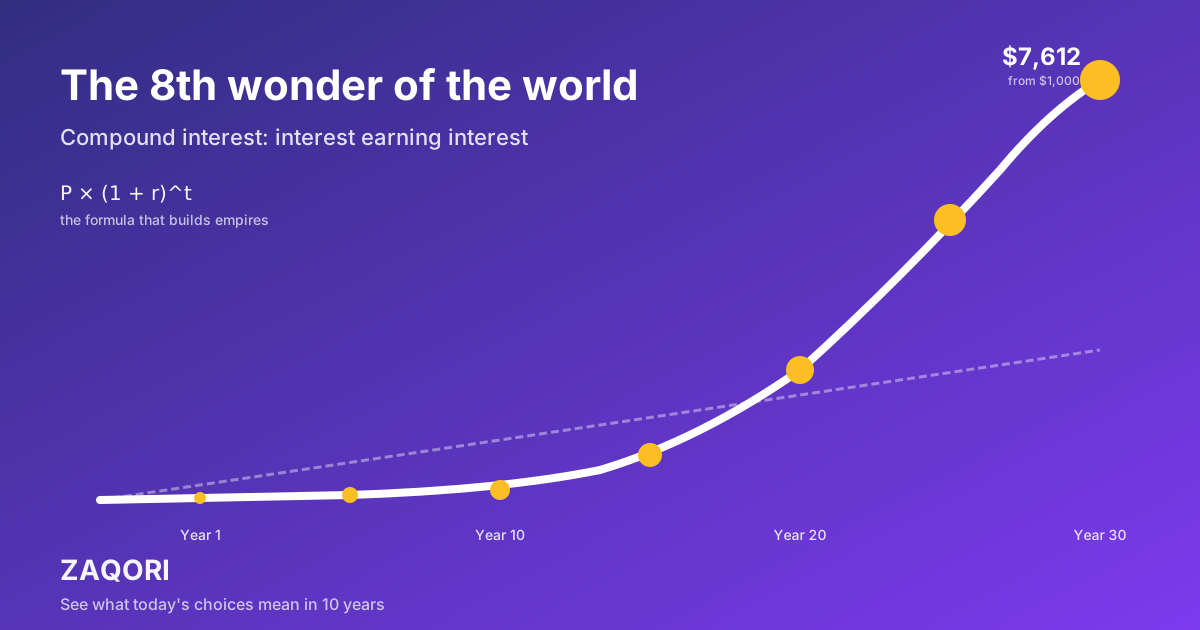
Albert Einstein reportedly called compound interest "the eighth wonder of the world." Whether or not he said it, the sentiment is correct. Compound interest is the single most powerful tool available to ordinary people for building wealth, and the vast majority of people either do not understand it or do not use it. This article explains what compound interest actually is, why it is so powerful, and how to make it work for you rather than against you.
What Compound Interest Actually Is
Compound interest is interest earned on interest. When you save or invest money and earn a return, that return is added to your principal. The next period, you earn returns on the new, larger principal. Then the next period, you earn returns on the even larger principal. The cycle repeats forever, and the result is exponential growth rather than linear growth. The Investment Growth Simulator lets you see this in real time with custom inputs.
With simple interest, $1,000 at 10% earns $100 per year, forever. After 30 years, you have $4,000. With compound interest, $1,000 at 10% earns $100 the first year, $110 the second year, $121 the third year, and so on. After 30 years, you have $17,449. The difference is the magic of compounding.
The Three Variables You Control
The size of your compounding result depends on three variables. The first is your starting principal. The second is the rate of return. The third is time. Of these three, time is the most powerful and the least appreciated.
Doubling your starting principal doubles your final result. Doubling your rate of return quadruples your final result. Doubling your time horizon increases your final result by 7-10x, depending on the rate. Time is more powerful than money, which is more powerful than returns. The Future Wealth Simulator shows this relationship in action.
This is why every financial advisor tells you to start investing as early as possible. A 25-year-old who invests $200/month for 40 years ends up with roughly the same balance as a 45-year-old who invests $800/month for 20 years, even though the older investor contributed twice as much total money. The younger investor's money had twice as much time to compound.
How Compounding Works Against You
Compound interest works for you when you are earning it. It works against you when you are paying it. Credit card debt, for example, compounds daily. A $1,000 credit card balance at 24% APR, if you only make minimum payments, will take 9 years to pay off and cost you $1,200 in interest. The Debt Payoff Simulator shows the long-term cost of carrying debt.
The same exponential curve that builds wealth when you are investing destroys wealth when you are borrowing. This is why avoiding high-interest debt is one of the most important financial decisions you can make. It is not just about paying less interest. It is about keeping the compounding curve on your side of the equation.
The Rule Of 72
A useful mental shortcut for compound interest is the Rule of 72. Divide 72 by your annual rate of return, and the result is the number of years it takes for your money to double. At 7%, money doubles in roughly 10 years. At 10%, money doubles in roughly 7 years. At 2%, money doubles in 36 years. The lower the return, the less compounding matters. The higher the return, the more compounding dominates.
This is why high-interest savings accounts are not enough for long-term wealth. At 1-2%, doubling takes 36-72 years. At 7% in a stock portfolio, doubling takes 10 years. The choice of return rate, sustained over decades, is the difference between modest growth and transformative wealth. The ZAQORI Investment Growth Simulator makes this vivid with side-by-side comparisons.
The Snowball Effect In Practice
Imagine three friends, all age 25, who each invest $200/month. Friend A invests in a 2% savings account and stops at 35. Friend B invests in a 7% balanced portfolio and continues to 65. Friend C does the same as Friend B but also reinvests all dividends.
Friend A ends with about $27,000. Friend B ends with about $530,000. Friend C ends with about $610,000. The difference is not the contribution amount. All three contributed identical sums in the early years. The difference is the compounding rate, sustained for 40 years. Time plus rate is the formula.
What Most People Miss
The most common mistake is focusing on the contribution amount rather than the duration and the return. People think "I cannot afford to invest $500/month, so I will invest $50." That is fine for starting. But they stay at $50 forever, even as their income grows. The Savings Growth Simulator shows the difference between flat contributions and contributions that grow with income.
The second most common mistake is cashing out. Every time you interrupt compounding, you reset the curve. Selling investments to buy a car, withdrawing retirement savings to pay for a wedding, cashing in stocks to cover an emergency — each of these breaks the compounding chain. The ZAQORI Future Wealth Simulator shows the dramatic impact of interrupting compounding even for a few years.
The third mistake is failing to reinvest. Many investments pay dividends or interest. If you take those distributions in cash, you lose the compounding. Reinvesting them is the difference between a 7% return and a 4-5% effective return.
How To Make Compounding Work For You
Open a brokerage or retirement account today. Invest in low-cost index funds. Set up automatic monthly contributions, even if small. Reinvest all dividends. Do not touch the money for 20+ years. Check your balance once a quarter, not once a day. Resist the urge to sell during market downturns. The discipline to stay invested through volatile periods is what separates people who get rich from people who do not.
The most important advice is the simplest: start. Compounding rewards time more than anything else. The best time to start was 20 years ago. The second best time is today. The worst time is "when I feel ready." You will never feel ready. The people who succeed are the people who start before they feel ready.
Frequently Asked Questions
Is 7% return realistic?
Historically, yes. The S&P 500 has returned about 10% nominal / 7% real over long periods. Past performance does not guarantee future results, but it is the best planning number we have.
What if I am starting late?
Start anyway. Compounding still works at 45. The result is smaller, but it is much better than not starting. Most people massively underestimate the value of starting "late" vs never starting.
Should I pick individual stocks or index funds?
For most people, low-cost index funds are the right answer. They give you diversification, low fees, and historically competitive returns. Stock picking adds risk and underperforms index funds for the majority of investors.
What about cryptocurrency or other "new" assets?
Treat them as a small speculative allocation (under 5%) if at all. The core of your wealth should be in boring, proven assets. Speculation can produce windfalls, but it is not a wealth-building strategy.
What if the market crashes right after I invest?
It will, eventually. That is normal. The market has crashed every decade or so for the last century. Each time, it recovered and went on to new highs. If your time horizon is 20+ years, crashes are buying opportunities, not disasters.
How do I actually start?
Open a Vanguard, Fidelity, or Schwab account. Link your bank. Buy a low-cost total market index fund. Set up automatic monthly contributions. That is the entire process.
The Takeaway
Compound interest is not a strategy. It is a force of nature. Once you understand it, the only question is which side of it you want to be on. The same exponential curve that turns $200/month into $500,000 over 40 years will turn $5,000 of credit card debt into $15,000 over 4 years if you only make minimum payments. The choice is yours, but it is not really a choice. It is just math. See your own compounding power at the Investment Growth Simulator.