Five dollars doesn't buy much these days. It's a small coffee, a fast food sandwich, a sandwich on the go, a digital song. Most of us drop five bucks without thinking twice, sometimes multiple times a day. So it's easy to assume that $5 is too small to matter in the long run. A rounding error. Nothing to plan around.
But here's the thing: the small amounts you stop noticing are exactly the amounts that quietly decide whether you build wealth or stay stuck. The difference between people who retire comfortably and people who don't often isn't a big salary. It's whether they protected the small stuff for long enough.
So what actually happens if you take just $5 a day and commit to saving it for 30 years? The answer is more dramatic than most people expect. Let me show you the real math, no fancy tricks, no "get rich quick" nonsense, just plain compound interest doing what it does over a long enough timeline.
The Real Math: $5 a Day Over 30 Years
Let's start with the raw, no-interest version. If you literally just stack $5 bills in a drawer for 30 years, you'll end up with:
$5 × 365 days × 30 years = $54,750
That's not nothing. Half a year's salary for many people, sitting there in cash. But it's also not life-changing money. You can't retire on it, can't buy a house with it, can't quit your job because of it.
Now let's add the part that makes this conversation interesting: compound interest. When you put that same $5 a day into something that earns a return, you don't just get your deposits back. You get interest on top of interest, year after year. That's the magic Albert Einstein allegedly called the eighth wonder of the world.
What Your $5 a Day Becomes at Different Returns
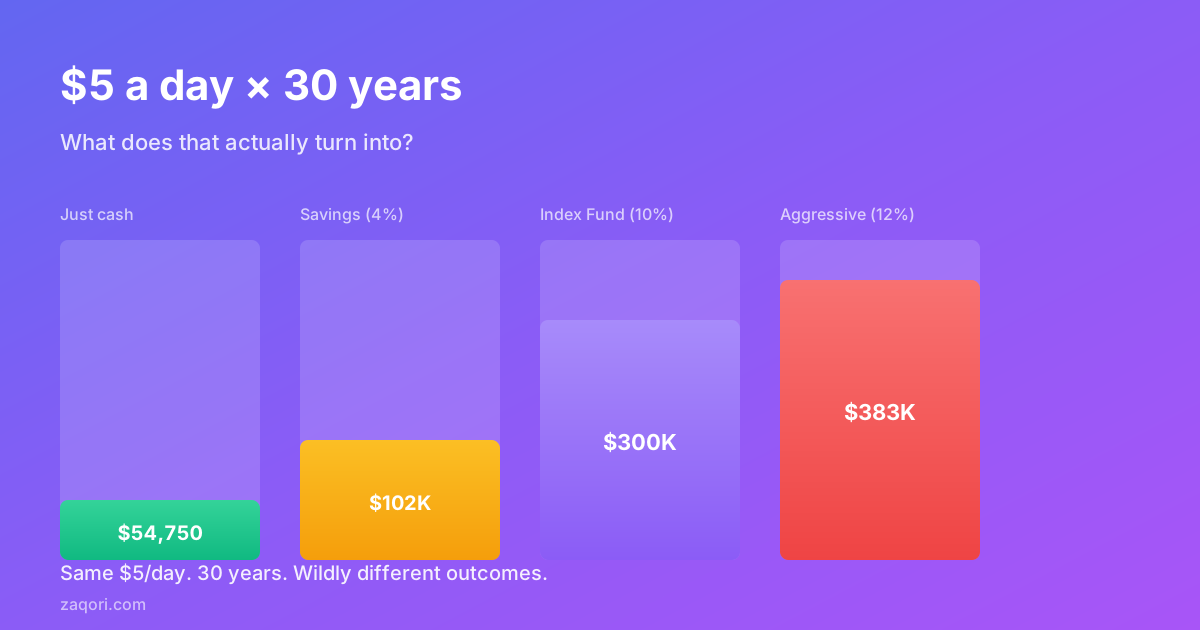
Here's a year-by-year look at what your $5-a-day habit turns into, depending on where you put it:
Read that again. The exact same daily habit, the same $5, gives you $54,750 in cash or $383,000 in a growth investment. That's a 7x difference, and it all comes down to where you put the money and how long you leave it alone.
How Compound Interest Actually Works
Most people understand saving: you put money in, the bank pays you a small amount of interest, the money grows slowly. Compound interest is the same idea, but with a twist that makes it vastly more powerful: you're earning interest on your interest, not just on your original deposits.
Here's a simple example. Suppose you put $1,000 in an account that pays 10% per year, and you never add another dollar. After year one, you have $1,100. After year two, you have $1,210, not $1,200, because that $100 of interest from year one is now also earning interest. After ten years, you have $2,593, not $2,000. After thirty years, you have $17,449, more than 17x your starting balance, with zero additional contributions.
Now layer in your daily $5 deposits, and the effect gets exponential. Your money is constantly working. Every dollar you add today has 30 years to grow. Every dollar you add in year ten has 20 years. Every dollar you add in year twenty has 10. The earlier dollars become the workhorses that produce the biggest returns.
Year-by-Year: Watching Your $5 Compound
One of the most underappreciated aspects of compounding is how it accelerates over time. The first ten years feel slow. The last ten years feel magical. Here's a snapshot at 10% annual return:
- Year 5: $9,850 (you put in $9,125, interest added $725)
- Year 10: $25,594 (you put in $18,250, interest added $7,344)
- Year 15: $52,946 (you put in $27,375, interest added $25,571)
- Year 20: $99,801 (you put in $36,500, interest added $63,301)
- Year 25: $178,253 (you put in $45,625, interest added $132,628)
- Year 30: $300,194 (you put in $54,750, interest added $245,444)
Notice how the interest line grows faster than your deposits. By year 15, the interest has caught up to your contributions. By year 20, interest is bigger than deposits. By year 30, interest is over 4x your deposits. This is the snowball effect that makes long-term investors genuinely wealthy, not their day jobs.
Real-World Examples: Who Actually Does This?
The numbers are abstract until you see them attached to actual people. Here are three profiles that show how $5 a day plays out in real life.
Sarah, the 22-Year-Old Barista
Sarah works part-time making $15 an hour. She skips her daily $5 latte from the cafe chain and instead puts that money in a Roth IRA invested in a total stock market index fund. She doesn't increase the amount when she gets a raise. She just keeps the $5 a day going, month after month, for the next 30 years. By age 52, her account is worth over $300,000, and that's not counting the raises she doesn't redirect into savings.
Marcus, the 35-Year-Old Teacher
Marcus is 13 years behind Sarah's timeline, so he only has 17 years of compounding ahead of him. He commits to the same $5 a day. By age 52, his account is worth about $130,000. Less than Sarah's, but still meaningful. The lesson: starting 13 years later cost him roughly $170,000 in final wealth. The earlier you start, the harder your money works.
Janet, the 50-Year-Old Planning for Retirement
Janet only has 15 years until her target retirement age. Same $5 a day. Same 10% return. Her account grows to about $95,000. Not enough to retire on, but a meaningful addition to her other retirement savings. Even late starters win by starting.
Where to Actually Put the Money
Saving $5 a day is half the equation. Where you put it determines whether you get $54,750 or $300,000. Here are the most realistic options, ranked by potential return.
High-Yield Savings Account (4-5%)
FDIC-insured, completely safe, instantly accessible. Great for emergency funds or short-term goals. For 30 years, you'll end up with around $102,000 to $142,000. Not bad, but not life-changing.
Index Funds (10-12% historically)
A low-cost S&P 500 index fund is the single most reliable wealth-building tool for the average person. You can open one in 10 minutes through Fidelity, Vanguard, Schwab, or any major brokerage. The historical average return is 10-12% per year. This is where $5 a day becomes $300,000.
Target-Date Funds
Even simpler than picking an index fund. Pick the year closest to when you'll need the money (say 2056) and the fund automatically adjusts its risk level as you approach that date. Set it and forget it.
Roth IRA or 401(k)
These aren't investments themselves; they're tax-advantaged accounts that hold your investments. A Roth IRA grows tax-free forever, and you can withdraw the original contributions anytime. If your employer offers a 401(k) match, take it, that's free money on top of your $5 a day.
Why $5 Specifically Works
There's a reason financial planners love the "$5 a day" example. It's psychologically small enough that almost anyone can find it, but large enough to matter over time. If you told a 22-year-old to save $300 a month, they'd panic. But $5 a day sounds like almost nothing, and yet over 30 years, it becomes $54,750 in raw deposits and over $300,000 with growth.
It also works because it doesn't require a big lifestyle change. You don't need to move to a smaller apartment or drive a worse car. You just need to redirect the small, easy spending that adds up to nothing. The daily coffee. The impulse snack. The streaming service you never watch. The Amazon order you forgot you made.
None of those cuts alone will change your life. But adding them all up and investing the difference, that's where wealth actually starts.
What Could Go Wrong?
To be honest with you: a lot, and you should know about it before you start.
Market downturns are real. The 10% average return assumes you stay invested through the bad years. In 2008, the S&P 500 dropped 37%. If you panic and sell in those moments, you lock in losses and break the compounding chain. The people who get rich from this strategy are the ones who never sell during a crash.
Inflation eats some of it. $300,000 in 30 years won't buy what $300,000 buys today. Historically, inflation runs around 3% per year, so the real (inflation-adjusted) value of your $300K is closer to $150,000 in today's dollars. Still a lot, but worth knowing.
You might not do it for 30 years. Most people who start a savings habit don't keep it up. Life gets in the way. You have a kid, lose a job, get a medical bill. The people who succeed build automation, not willpower: set up automatic transfers, automatic investments, and never let the decision be a daily question.
The Conclusion: Small Streams, Big Rivers
$5 a day for 30 years is, in some ways, the simplest financial plan you could ever follow. There are no fancy derivatives, no hot stock tips, no get-rich-quick schemes. Just one daily decision, repeated with discipline, compounded by time and market returns.
The numbers are real. $54,750 in raw deposits. $102,000 in a savings account. $300,000 in an index fund. $383,000 in an aggressive growth portfolio. The same $5 a day, the same 30 years, dramatically different outcomes based on a single choice: where you put it.
The hardest part isn't the math. The math is simple. The hardest part is starting, and then not stopping. Once you do, time does most of the work for you.
So if you've been waiting for a sign to start saving, this is it. Five dollars. Every day. For 30 years. You won't notice the spending you gave up, but your future self will absolutely notice the wealth you built.
See Your Own Numbers
Curious what $5 a day looks like in your life? Use the ZAQORI Future Wealth Simulator to model different amounts, time horizons, and returns. Free, instant, no sign-up required.
Open the Future Wealth Simulator →